

Medical Disclaimer: This article is for educational purposes only and does not substitute professional medical advice. If your neck pain follows trauma or is accompanied by arm numbness, weakness, or dizziness, seek medical attention immediately.
Severe neck pain rarely gives you warning. One morning you wake up unable to turn your head, or you stand up from your desk and feel a deep, grinding tightness that stops you mid-movement. Before reaching for painkillers, here are the four most effective home interventions:
Quick Relief Checklist:
- ✅ Apply cold (first 0 to 48 hours) to reduce muscle spasm and inflammation
- ✅ Transition to heat (after 48 hours) to restore blood flow and loosen stiff tissue
- ✅ Do 2 to 3 targeted stretches from the physical therapy protocols below, gently, within a pain-free range
- ✅ Fix one ergonomic factor today, either screen height or pillow position, to stop re-aggravating the injury
What Actually Causes Your Severe Neck Pain
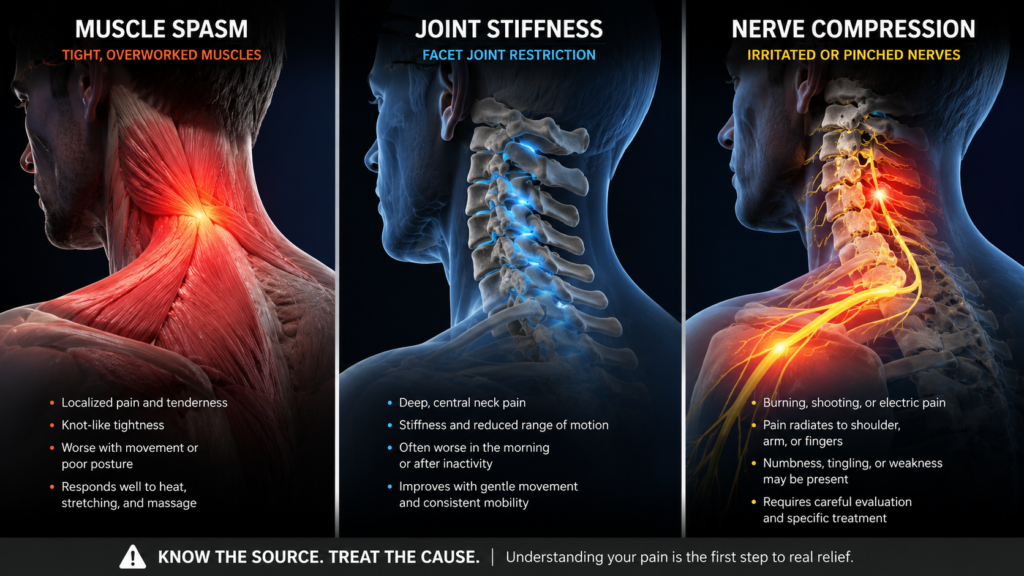
Most people skip this step and go straight to remedies. That is a mistake, because ice works differently on a muscle spasm than on joint stiffness, and stretching a nerve-related problem without knowing it can make things significantly worse.
Muscle spasm feels localized and knotted. You can press on the area and feel a dense, tender band. Movement is restricted but muscular, like something is gripping and will not let go. This is the most common cause in office workers and responds well to everything covered below.
Joint stiffness feels deeper and more central. Rotation to one side may be almost completely blocked, with a dull ache that gradually loosens as you move through the morning.
Nerve involvement requires the most caution. Watch for burning or shooting sensations traveling into the shoulder or fingers, numbness in specific fingers, or weakness when gripping. These symptoms mean the approach changes entirely, and pushing through stretches that feel helpful for muscle spasm can actively aggravate a compressed nerve root.
Understanding which category your pain falls into takes 60 seconds and determines which tools will actually help you recover faster.
Heat or Ice? Getting the Protocol Right
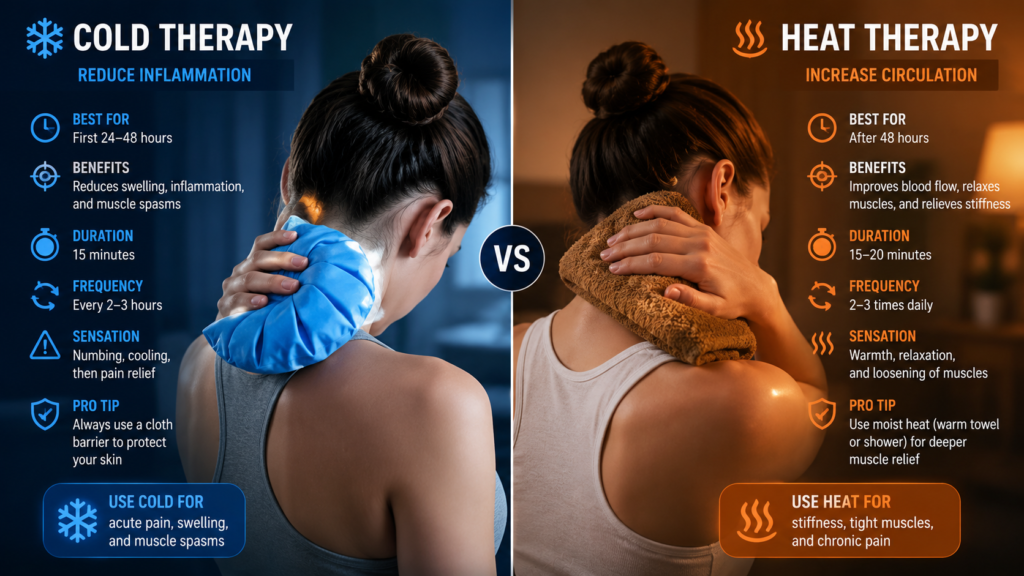
Getting this wrong does not just delay recovery. Applying heat to an acutely inflamed muscle in the first 48 hours can genuinely worsen the spasm by increasing blood flow to already reactive tissue.
| Cold / Ice | Heat | |
|---|---|---|
| Best for | First 24 to 48 hours, acute spasm | After 48 hours, chronic stiffness |
| How long | 15 minutes on, 45 minutes off | 15 to 20 minutes maximum |
| Correct sensation | Numbing, then dull ache relief | Muscles softening and spreading warmth |
| Stop immediately if | Skin turns red or white | Pain throbs or headache begins |
Always wrap an ice pack in a cloth before applying it. Direct skin contact causes cold burns. For heat, wet heat such as a warm damp towel or a shower directed at the neck penetrates deeper into muscle tissue than a dry heating pad and will produce noticeably better results.
3 Physical Therapist Approved Stretches for Severe Neck Pain
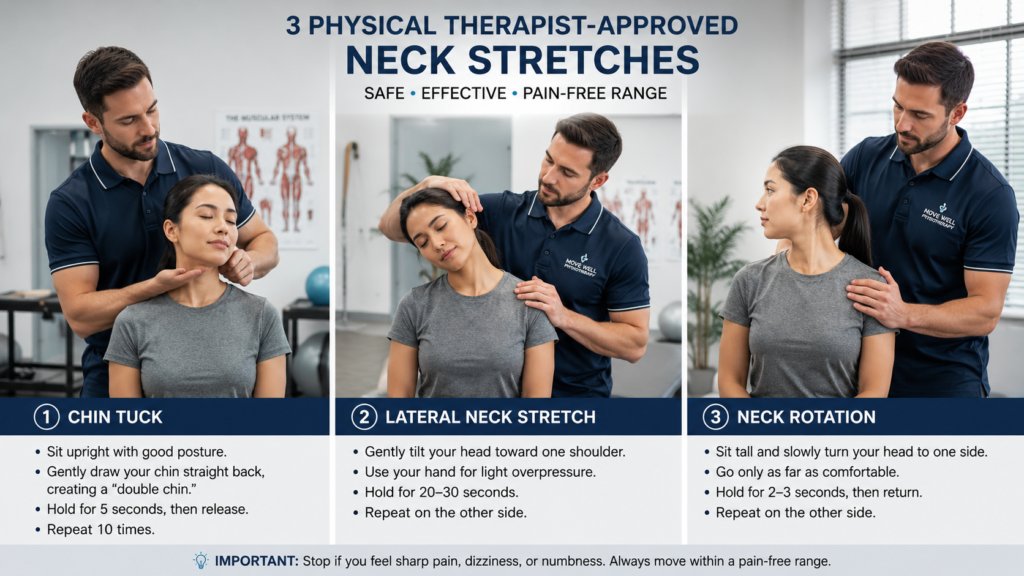
One rule applies without exception: work within a pain-free range, not through pain. A mild pulling sensation is correct. A sharp, electric, or shooting sensation means stop immediately and return to neutral. Always perform these after applying heat, never before.
Chin Tuck — Deep Cervical Flexor Activation
10 repetitions, 5-second hold each, twice daily
Sit upright with your back supported and shoulders relaxed. Without tilting your chin up or down, gently draw your head straight backward as though making a double chin. The movement is purely horizontal. Hold 5 seconds, then release.
Correct sensation: A gentle deep pulling at the base of the skull and a sense of the neck lengthening upward.
Stop if: Any shooting sensation travels into your shoulder or arm, or dizziness occurs.
Lateral Neck Stretch — Upper Trapezius Release
3 repetitions each side, 20 to 30-second hold
Sit tall and drop your right ear toward your right shoulder without raising the shoulder to meet it. Stop at the first point of mild resistance. Place your right hand gently on top of your head and allow the weight of the hand alone to deepen the stretch slightly. Hold 20 to 30 seconds, then return to center with control.
Correct sensation: A clear pulling from behind the ear down toward the top of the shoulder, felt entirely in the muscle.
Stop if: A burning or radiating sensation travels down the arm.
Controlled Neck Rotation
5 repetitions each direction, slow and controlled, once daily
Begin with a slight chin tuck to establish a neutral spine position. Slowly rotate your head to the right only as far as comfortable, which during an acute episode may be just 20 to 30 degrees. Pause briefly, then return to center. Repeat to the left.
Correct sensation: Mild tightening on the opposite side from the direction of rotation. Range should gradually increase over several days as muscle guarding reduces.
Stop if: Any rotation produces dizziness or a shooting sensation.
Avoid entirely: Neck circles, forceful self-cracking, and foam rolling directly over the cervical spine. These movements load compromised structures and consistently aggravate rather than relieve acute neck pain.
Two Ergonomic Fixes That Prevent Recurrence
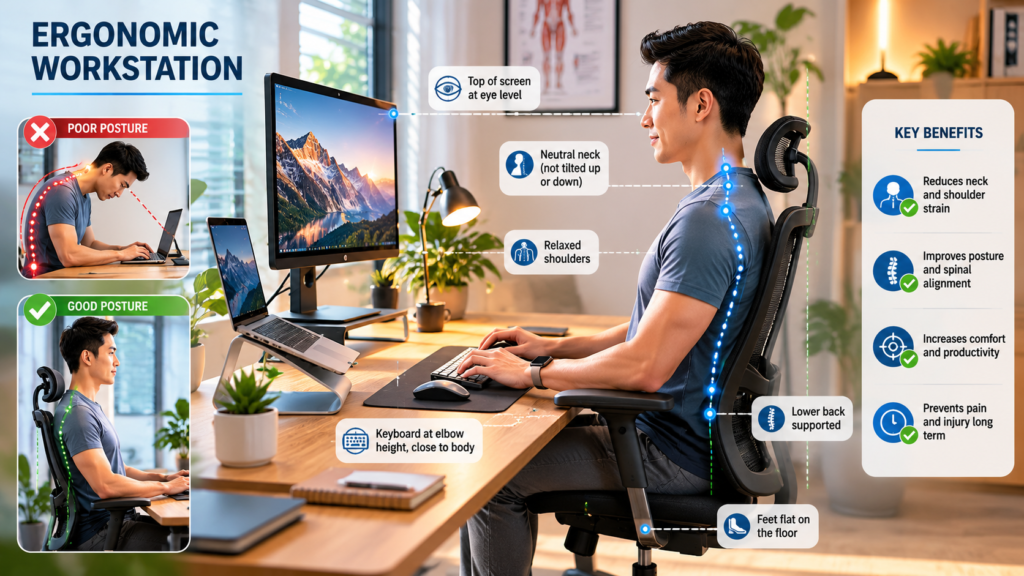
Treating the pain is necessary. Not recreating it every day is equally important.
Monitor Height
The top of your screen should sit at or just below eye level. If you use a laptop flat on a desk, you are sustaining a forward head posture that multiplies the mechanical load on your cervical spine many times over for hours each day. No amount of stretching will fully compensate for this. An external keyboard and laptop stand is the practical solution.
Pillow Height
For side sleepers, your ear should align with your shoulder so the neck stays in a neutral lateral position. A pillow too thin lets the head drop toward the mattress. A pillow too thick pushes it upward. Both produce stiffness and pain by morning. For back sleepers, the pillow should fill the gap between the back of your head and the mattress without pushing your chin toward your chest.
When to See a Doctor: Red Flags You Must Not Ignore

See a doctor within 24 hours if:
- Pain began after a fall, accident, or direct impact to the head or neck
- Neck pain is accompanied by fever, unexplained weight loss, or night sweats
- Pain has not improved at all after 7 days of consistent home care
Go to the emergency room immediately if:
- You experience a sudden severe headache described as the worst of your life
- Neck pain is accompanied by inability to touch your chin to your chest and fever
- You develop sudden weakness in the arms, difficulty walking, or loss of bladder control
- Numbness or tingling spreads into both arms simultaneously
- Sudden dizziness, double vision, or difficulty swallowing accompanies the neck pain
Erring toward caution in this category is never the wrong decision.
Your 3 Day Action Plan
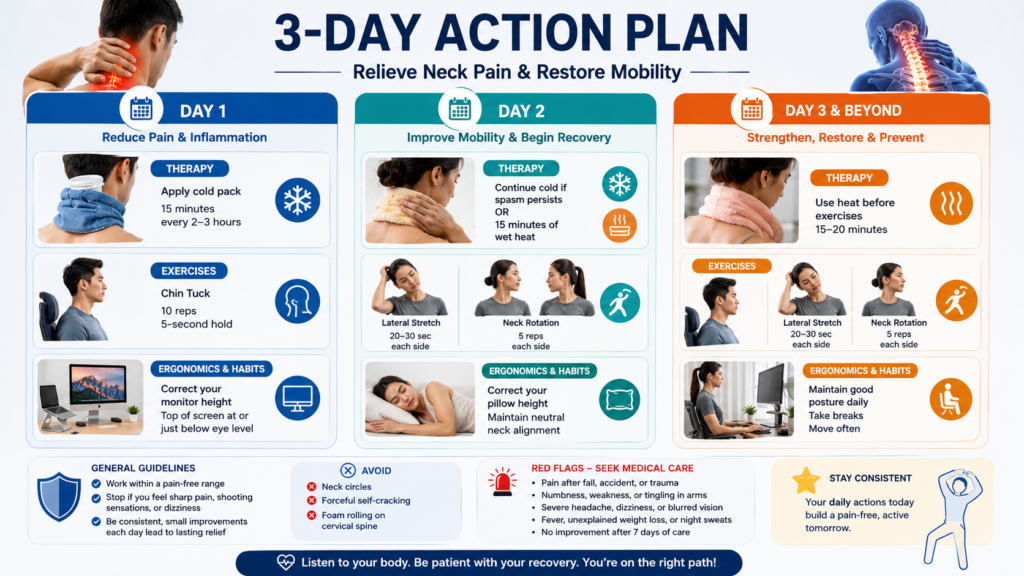
Day 1: Apply cold for 15 minutes every 2 to 3 hours. Do 10 chin tucks in a supported chair. Correct your monitor height.
Day 2: Continue cold if acute spasm persists, or transition to 15 minutes of wet heat if the initial intensity has reduced. Add the lateral stretch and controlled rotation. Correct your pillow height before sleeping.
Day 3 onward: Shift fully to heat before exercises. Perform all three stretches once daily. If pain is not meaningfully improving by day 7, book an appointment with a physician or physiotherapist rather than continuing to self-manage.